Gluco Mild Official Website › How it works
How it worksHow Does Gluco Mild Work? Three Ideas in One Bottle
Gluco Mild combines three separate approaches in one dropper bottle.
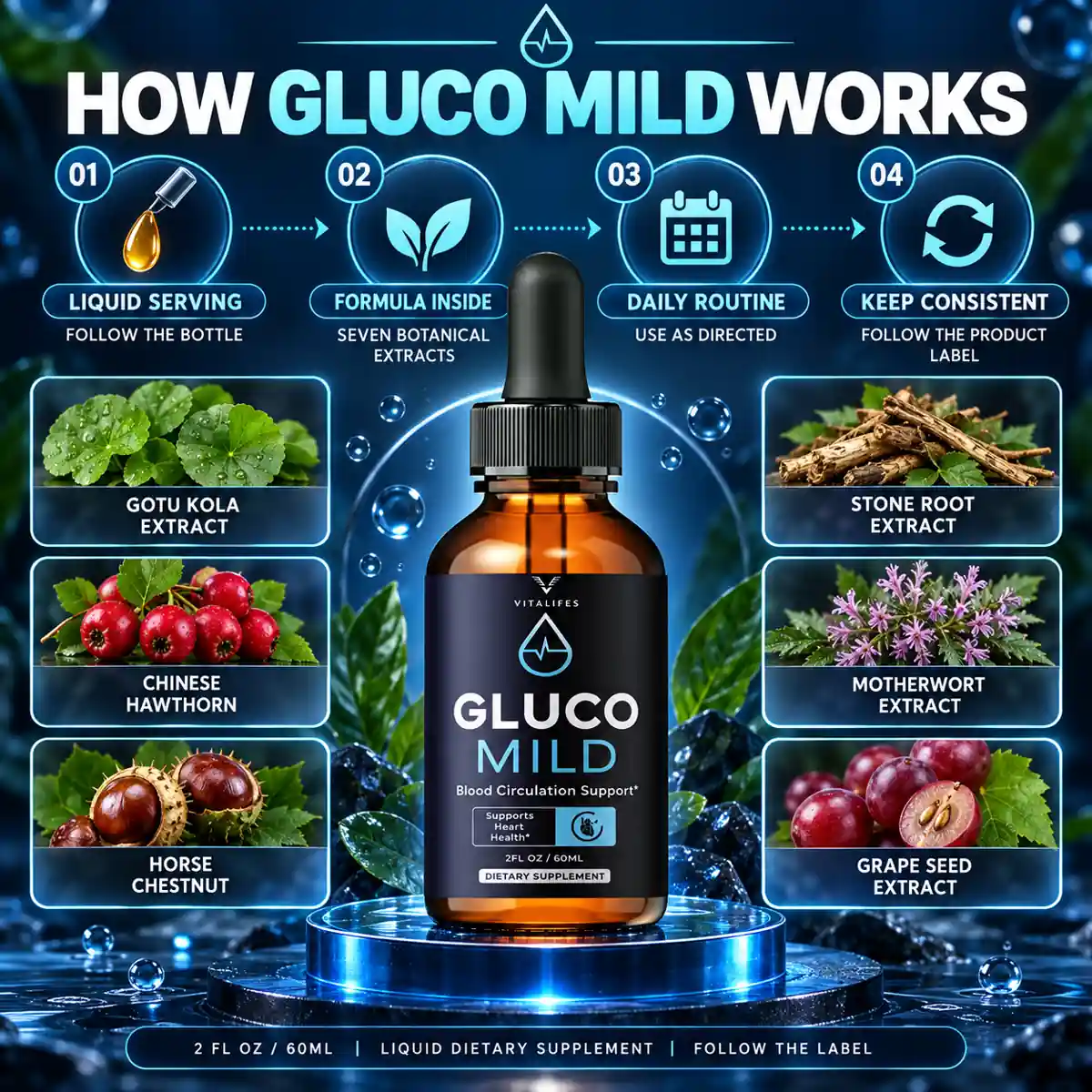
Horse chestnut, butcher's broom and gotu kola are venoactive plants with pooled human trials. Hawthorn is there for heart health support, and grape seed has been measured at the artery lining.
For the full plant list, see Gluco Mild ingredients.
Three mechanisms, the studies behind each, and the honest size of what they found.
What Gluco Mild is proposed to act on
Before any ingredient does anything, it is worth knowing what it is proposed to do it to.
A vein in the leg is a tube with one-way valves in it and a muscle pump around it. Walking squeezes the calf, the calf squeezes the veins, and the valves stop the blood that has been pushed upward from falling back. The review of how venous disease develops describes what happens when those valves stop closing cleanly: pressure builds in the vein below them, the vessel wall stretches, and fluid begins to leak into the tissue around it.
That sequence explains the symptoms people in this category describe. Swelling that arrives during the day and eases overnight is fluid following gravity. Heaviness is the same fluid in the tissue. The whole venoactive drug class, of which the botanicals in this bottle are the food-supplement wing, is aimed at two points in that sequence: the tone of the vessel wall, and the leakiness of the small vessels at the end of it.
The first Gluco Mild mechanism: tone in the vessel wall
The part of this formula with genuine human trials behind it, and the size of what those trials found.
Three of the seven botanicals belong to this idea. Horse chestnut, butcher's broom and gotu kola are all described as venotonic: proposed to make a stretched vein contract slightly and to reduce how much fluid escapes from the smallest vessels.
The evidence here is the best this formula has. The Cochrane review of horse chestnut seed extract pooled seventeen randomised trials and found reductions in leg pain, swelling and itching against placebo, and the earlier criteria-based review by the same authors reached the same conclusion working from a different set of inclusion rules. The pooled analysis of the butcher's broom combination product measured leg volume and ankle circumference rather than asking people how they felt, and a clinical review of Ruscus in leg swelling sets that work beside the rest of the category.
Gotu kola's contribution is the most mechanistic of the three. The capillary filtration study measured the rate at which fluid crosses out of the small vessels in the ankle, before and after treatment, and a twelve-month placebo-controlled study followed the same fraction over a year. Those are direct measurements of the leak rather than reports of comfort, which is what makes them interesting.
Across the category, the 2020 Cochrane review of phlebotonics concluded that these agents probably reduce oedema slightly compared with placebo, with little or no difference in quality of life and moderate certainty at best. Slightly is the word the evidence supports, and it is the word this desk uses.
The second Gluco Mild mechanism: the hawthorn literature
One ingredient here has been studied in a diagnosed condition. That is a strength and a complication at the same time.
Hawthorn is studied in a different organ for a different reason, and its trials were run in a clinical population rather than in people with tired legs. A meta-analysis of ten randomised trials found the standardised extract improved maximal workload and symptom scores in chronic heart failure, and the Cochrane review reached a comparable conclusion on the same population.
The proposed action is on the heart muscle itself and on the vessels it pumps into: a modest increase in the force of contraction and a modest relaxation of the arteries, producing a heart that does the same work at a lower cost. That is a coherent story, and it is the reason the front of this bottle carries a heart line as well as a circulation line.
Three conditions travel with that story and none of them is optional. The participants had a diagnosis. They were taking prescribed heart medicine at the same time. And the extract was standardised and given at a stated daily weight for months or years. A supplement bought online reproduces none of the three, and who it is for explains why the second condition in particular matters to anyone already on a prescription.
The third Gluco Mild mechanism: the lining of the vessel
The third idea in the bottle is about arteries rather than veins, and it is measured in a way the others are not.
Grape seed works on a different surface again. The inner lining of an artery, the endothelium, releases nitric oxide and the vessel widens in response; how well it does that is measurable, and the measurement is called flow-mediated dilation.
A dose-response meta-analysis of grape seed extract found an improvement in that measure, and a meta-analysis of sixteen randomised trials found small reductions in blood pressure. Proanthocyanidins are the compounds credited with it, and they are what a grape seed extract is standardised for when anyone bothers to standardise it.
Motherwort is placed in this group on the strength of laboratory work rather than trials. The review of its phytochemistry and pharmacology describes effects on cardiac and vascular tissue in cells and animals, which is a reason to be interested and not a reason to expect anything. Stone root has no mechanism study of any kind, and this website never assigns it one.
What this mechanism story has going for it
- Three venoactive botanicals with pooled randomised evidence behind the class.
- One ingredient with a two-year trial, in an organ the label names.
- One ingredient with direct measurements of vessel function, not just symptom scores.
- Three of the four mechanisms are measurable rather than theoretical.
What it cannot carry
- Every measurement above belongs to a stated weight of a standardised extract.
- Two of the seven have no human evidence at all behind the mechanism they are placed in.
- The heart evidence belongs to leaf and flower; this graphic names fruit.
- Nothing published connects any of it to two drops of an unquantified liquid.
Why the Gluco Mild directions put the drops after a meal
One line of the directions has a pharmacological reason behind it, and it is worth a paragraph.
The bottle says to take the drops after a meal, and that instruction is not decoration. Two things sit behind it.
The first is tolerance. The horse chestnut trial record lists gastrointestinal discomfort among the reported complaints, which is what saponins tend to produce on an empty stomach. The chemistry of escin is exactly the sort that irritates a gut lining when it arrives undiluted. Food blunts that.
The second is that several of these compounds are fat-associated. A meal containing any fat at all gives them something to travel with. Neither point is dramatic, and together they explain a direction that costs a buyer nothing to follow.
Honest critique: what no Gluco Mild mechanism can do
This is the section that says what the three mechanisms above are not.
A mechanism is a proposal about how something might act. It is not a result, and the distance between the two is where most supplement marketing lives.
Nothing described on this page repairs a vein valve. Valves that have stopped closing do not start again, and the 2023 American vascular-society guidelines describe what actually gets done about them. Nothing here clears a narrowed artery. Nothing here replaces a prescribed heart medicine, and stopping one because a supplement arrived is the single worst decision anyone reads their way into in this category.
The 2024 update on herbal drugs in venous disease is candid about the state of the field: promising chemistry, a thin and heterogeneous trial base, and a persistent gap between what the plants do in a laboratory and what they do in a person. This bottle sits inside that gap along with everything else on the shelf beside it.
Questions about how Gluco Mild works
How long does Gluco Mild take to do anything?
The trials behind these plants ran eight to twelve weeks before measuring, and the hawthorn work ran for two years. Buyers of this product most often describe four to eight weeks before deciding. The timeline page sets the two side by side.
Does Gluco Mild thin the blood?
The label claims nothing of the kind. Grape seed polyphenols do show anticoagulant and antiplatelet activity in laboratory work, which is a safety point rather than a benefit, and anyone taking warfarin or another blood thinner should say what they are taking before starting anything botanical.
Is the Gluco Mild mechanism the same as a compression stocking?
No, and the comparison is useful. A stocking applies pressure from outside and works the moment it is on. A venoactive botanical acts on the vessel wall from inside and is measured in weeks. The guidelines put compression first for a reason.
Why does Gluco Mild contain two ingredients with no evidence?
Stone root and motherwort are traditional inclusions in circulatory formulas and have been for a long time. That is the honest reason. It is a reason a plant appears on a label, and this desk prints it rather than borrowing a sentence from the plants with real trials beside them.
Does Gluco Mild work better than one ingredient on its own?
Nobody has tested it, so nobody knows. Combination products in this category are usually assumed to add up and are rarely compared against their own parts. The Cochrane phlebotonics review assesses the class rather than individual formulas.
Can Gluco Mild be taken alongside a prescribed heart medicine?
That is a question for the prescriber who wrote it, and there is one specific reason rather than a general one: hawthorn has a measured interaction with digoxin studied in people. The side-effects page names it.
Sources for the Gluco Mild mechanisms
Every review and trial named above, in the order its mechanism appears.
- Incandela L, Belcaro G, Cesarone MR, et al. Treatment of diabetic microangiopathy and edema with total triterpenic fraction of Centella asiatica: a prospective, placebo-controlled randomized study. Angiology. 2001;52 Suppl 2:S27-31. PMID 11666119. https://pubmed.ncbi.nlm.nih.gov/11666119/
- Belcaro GV, Rulo A, Grimaldi R. Capillary filtration and ankle edema in patients with venous hypertension treated with TTFCA. Angiology. 1990;41(1):12-8. PMID 2305995. https://pubmed.ncbi.nlm.nih.gov/2305995/
- Pittler MH, Schmidt K, Ernst E. Hawthorn extract for treating chronic heart failure: meta-analysis of randomized trials. Am J Med. 2003;114(8):665-74. PMID 12798455. https://pubmed.ncbi.nlm.nih.gov/12798455/
- Pittler MH, Guo R, Ernst E. Hawthorn extract for treating chronic heart failure. Cochrane Database Syst Rev. 2008;2008(1):CD005312. PMID 18254076. https://pubmed.ncbi.nlm.nih.gov/18254076/
- Pittler MH, Ernst E. Horse chestnut seed extract for chronic venous insufficiency. Cochrane Database Syst Rev. 2012;11(11):CD003230. PMID 23152216. https://pubmed.ncbi.nlm.nih.gov/23152216/
- Pittler MH, Ernst E. Horse-chestnut seed extract for chronic venous insufficiency. A criteria-based systematic review. Arch Dermatol. 1998;134(11):1356-60. PMID 9828868. https://pubmed.ncbi.nlm.nih.gov/9828868/
- Savarino P, Colson E, Andre J, et al. Horse Chestnut Saponins-Escins, Isoescins, Transescins, and Desacylescins. Molecules. 2023;28(5):2087. PMID 36903330. https://pubmed.ncbi.nlm.nih.gov/36903330/
- Wojtyniak K, Szymanski M, Matlawska I. Leonurus cardiaca L. (motherwort): a review of its phytochemistry and pharmacology. Phytother Res. 2013;27(8):1115-20. PMID 23042598. https://pubmed.ncbi.nlm.nih.gov/23042598/
- Boyle P, Diehm C, Robertson C. Meta-analysis of clinical trials of Cyclo 3 Fort in the treatment of chronic venous insufficiency. Int Angiol. 2003;22(3):250-62. PMID 14612852. https://pubmed.ncbi.nlm.nih.gov/14612852/
- Bihari I, Guex JJ, Jawien A, et al. Clinical Perspectives and Management of Edema in Chronic Venous Disease-What about Ruscus? Medicines (Basel). 2022;9(8):41. PMID 35893088. https://pubmed.ncbi.nlm.nih.gov/35893088/
- Zhang H, Liu S, Li L, et al. The impact of grape seed extract treatment on blood pressure changes: A meta-analysis of 16 randomized controlled trials. Medicine (Baltimore). 2016;95(33):e4247. PMID 27537554. https://pubmed.ncbi.nlm.nih.gov/27537554/
- Foshati S, Nouripour F, Sadeghi E, et al. The effect of grape (Vitis vinifera) seed extract supplementation on flow-mediated dilation, blood pressure, and heart rate: A systematic review and meta-analysis of controlled trials with duration- and dose-response analysis. Pharmacol Res. 2022;175:105905. PMID 34798267. https://pubmed.ncbi.nlm.nih.gov/34798267/
- Martinez-Zapata MJ, Vernooij RW, Simancas-Racines D, et al. Phlebotonics for venous insufficiency. Cochrane Database Syst Rev. 2020;11(11):CD003229. PMID 33141449. https://pubmed.ncbi.nlm.nih.gov/33141449/
- Bencsik T, Balazs VL, Farkas A, et al. Herbal drugs in chronic venous disease treatment: An update. Fitoterapia. 2024;179:106256. PMID 39419127. https://pubmed.ncbi.nlm.nih.gov/39419127/
- Mansilha A, Sousa J. Pathophysiological Mechanisms of Chronic Venous Disease and Implications for Venoactive Drug Therapy. Int J Mol Sci. 2018;19(6):1669. PMID 29874834. https://pubmed.ncbi.nlm.nih.gov/29874834/
- Gloviczki P, Lawrence PF, Wasan SM, et al. The 2023 Society for Vascular Surgery, American Venous Forum, and American Vein and Lymphatic Society clinical practice guidelines for the management of varicose veins of the lower extremities. Part II. J Vasc Surg Venous Lymphat Disord. 2024;12(1):101670. PMID 37652254. https://pubmed.ncbi.nlm.nih.gov/37652254/
Order Gluco Mild knowing which part of it is doing the work
Three venoactive botanicals, one heart-literature ingredient, one measured at the artery lining, and two that are here on tradition. Two drops a day after a meal.
Seven named botanicals · 2 fl oz (60 ml) · price and return window shown at checkout
Order Gluco Mild On The Official WebsiteTwo drops daily after a meal · 2 fl oz (60 ml) a bottle · lot GLU-26/TH-7250