Gluco Mild Official Website › Blog › Stone Root And Motherwort
Stone Root And Motherwort: What The Published Record Shows
Two of the seven names on this label have no human trial behind them at all. That is not an accusation, it is the state of the literature, and it is more interesting than it sounds once you look at what is actually there.
- A database search for stone root returns four records, two of them from the 1880s.
- There is no controlled human trial of stone root for circulation, for veins, or for anything else.
- Motherwort has a real pharmacology in cells and animals and a long traditional record.
- It has no randomised human cardiovascular trial at any dose.
- Motherwort's constituents act on uterine smooth muscle, which is the specific reason this bottle is not for anyone pregnant.
- Naming these two as traditional ingredients is honest. Naming them as evidence would not be.
What a search for stone root returns
Stone root is Collinsonia canadensis, a North American plant with a long history in nineteenth-century eclectic medicine, where it was used for haemorrhoids, varicose veins and throat complaints.
Search the modern bibliographic database for it and this is the complete return.
| What a search for Collinsonia canadensis returns | Year | What it is |
|---|---|---|
| A note in the British Medical Journal | 1887 | A nineteenth-century clinical note, predating controlled trials as a concept. |
| A note in the Southern Medical Record | 1888 | The same kind of document, a year later. |
| A phytochemistry paper isolating a flavanone | 1999 | Laboratory chemistry. It identifies a compound; it does not study an effect in people. |
| An in-vitro breast-carcinoma screen | Modern | Cell work in an unrelated indication. |
Four records in the modern bibliographic database. There is no randomised trial, no controlled trial, and no human study of stone root for circulation at any dose.
Four records. The 1999 phytochemistry paper is the only modern piece of laboratory work on the plant, and it reports the isolation of a novel 2-hydroxyflavanone. That is a genuine contribution to chemistry and it establishes nothing about what the plant does in a person.
No efficacy sentence about stone root can honestly be written from that, and none appears anywhere on this website. The two records are cited here and in the reference list precisely as the proof of an absence, which is an unusual use for a citation and the right one.
Reading a nineteenth-century clinical note
The 1887 note in the British Medical Journal is worth a paragraph on its own, because it is easy to either overvalue or dismiss.
It is a short clinical communication from an era before randomisation, before placebo controls, before blinding and before the statistical apparatus that lets anybody distinguish an effect from an impression. A physician wrote down what he had observed. That was the state of the art and it was published in a serious journal.
What it tells a modern reader is that the plant was used, by practitioners, for a defined set of complaints. That is real information about a tradition. It is not information about whether the plant works, because the method that would answer that question had not been invented yet and has never subsequently been applied here.
A citation to an 1887 note is sometimes used to make a supplement look well documented. It does the opposite, and it should: a plant whose most recent clinical record is a hundred and forty years old has not been studied.
What the motherwort record contains
Motherwort, Leonurus cardiaca, is a different case and a more interesting one. The species name carries the traditional use in it, and the traditional use is cardiac.
| The motherwort record | What it contains | What it does not |
|---|---|---|
| The European assessment report update | A survey of constituents, traditional use and pharmacology. | Any randomised controlled trial in cardiovascular disease. |
| A phytochemistry and pharmacology review | Alkaloids, iridoids, diterpenes, and their activity in cells and animals. | A human efficacy study at a stated dose. |
| A study of uterine smooth muscle | Direct evidence that constituents act on uterine tissue. | Anything reassuring about use in pregnancy — the opposite. |
Traditional use plus modern pharmacology. That is a real body of work and it is not the same kind of thing as a trial.
The update to the European Medicines Agency assessment report is the most substantial document here. It surveys the constituents, the traditional applications and the modern pharmacological work, and it is a serious piece of scholarship.
A phytotherapy review of the plant covers the same ground from the pharmacology side: alkaloids, iridoids, diterpenes, and a range of activities demonstrated in cells and in animals.
What neither describes is a randomised controlled trial in people. There is an activity profile and a tradition, and the step from those to a clinical claim has not been taken. That step is not a formality; it is where a great many promising plant pharmacologies stop being promising.
See all seven Gluco Mild names with their records
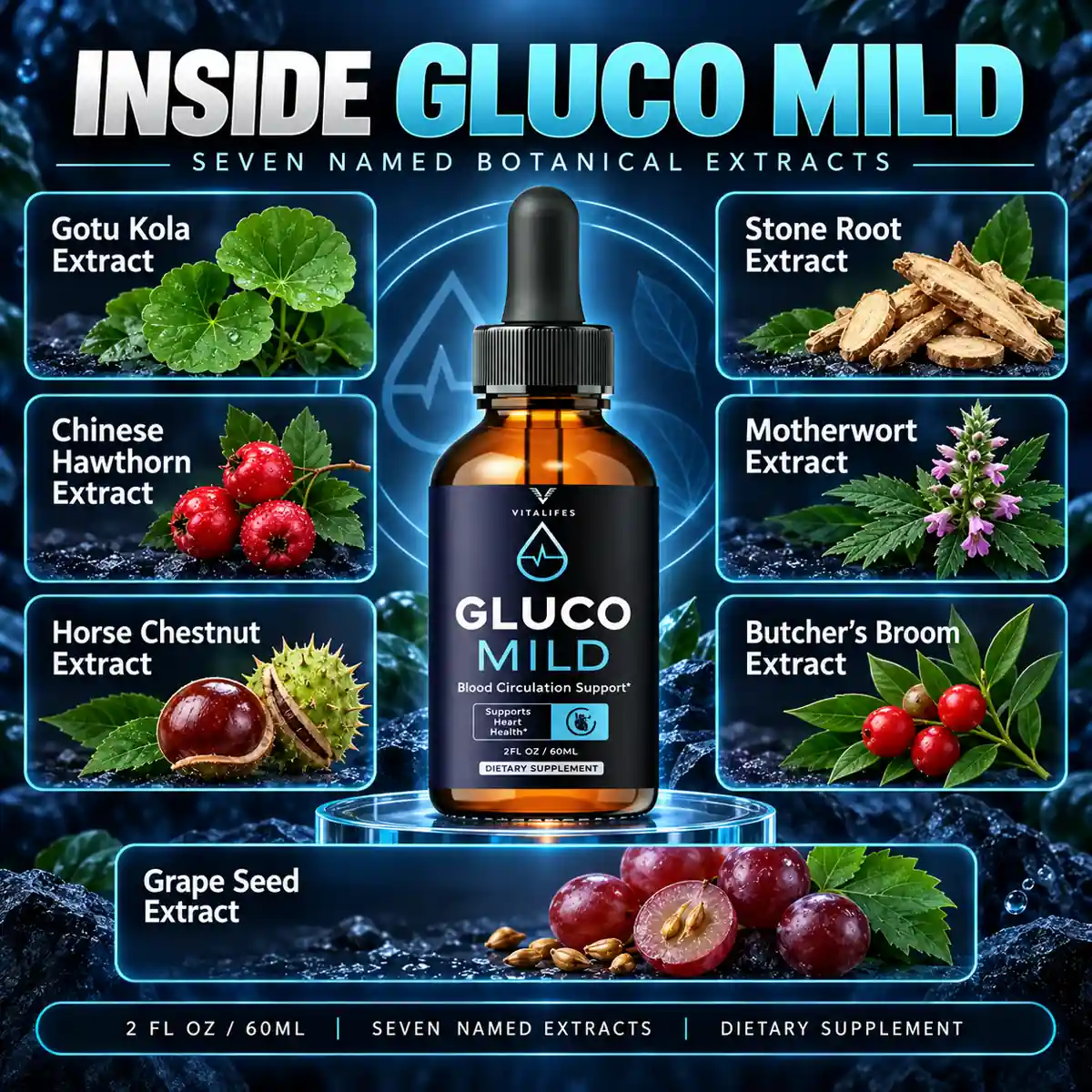
Two with no human trial, one with heart evidence rather than leg evidence, four with controlled trials at a stated daily amount. The ingredients page prints the record against each one.
Seven named botanicals · 2 fl oz (60 ml) · price and return window shown at checkout
Order Gluco Mild On The Official WebsiteTwo drops daily after a meal · 2 fl oz (60 ml) a bottle · lot GLU-26/TH-7250
The one motherwort finding with a direct practical consequence
There is one piece of this literature that changes what somebody should do, and it deserves to be stated once, precisely, rather than buried in a general caution.
A 2018 phytochemistry study of Leonurus japonicus examined alkaloids and flavonoid glycosides from the aerial parts and their opposite effects on uterine smooth muscle. The plant's constituents act on uterine tissue. That is the pharmacology, it is not disputed, and it is consistent with the plant's other traditional use.
The consequence is concrete. This bottle is not for anyone pregnant or trying to conceive, and the reason is that specific finding about that specific ingredient rather than the blanket caution a supplement label usually carries.
Stating it that way is more useful to a reader than five vague hedges, and it is the house rule on this website: name the actual interaction once, in the section whose job it is, instead of gesturing at risk everywhere.
Why plants with no trials appear on labels
This is not a scandal and it is worth explaining rather than insinuating.
Traditional formulations are assembled from traditional pairings. Stone root and motherwort have sat alongside horse chestnut and butcher's broom in circulatory preparations for a very long time, and a formulator working in that tradition includes them because the tradition does.
There is also a straightforward economic reason nobody has run the trial. A randomised controlled trial costs a great deal of money, and nobody can patent a plant. The funding that produced the horse chestnut literature came largely from manufacturers of standardised extracts who had a product to sell at the end of it. No such product exists for stone root.
So the absence of evidence here is mostly an absence of funding rather than a record of failure. That is a meaningful distinction, and it cuts both ways: it means the plants have not been shown not to work, and it means nobody can say that they do.
How to check a traditional ingredient on any label
This is a habit rather than a fact about these two plants, and it takes a couple of minutes on a phone.
Search the botanical name instead of the common one. Common names are ambiguous across countries and across centuries; a binomial is not. Stone root is Collinsonia canadensis and motherwort is Leonurus cardiaca, and both appear in the distributor's own paperwork for this bottle.
Then read what comes back for its type rather than its quantity. A long list of laboratory papers is a pharmacology, which is a real body of work and is not a clinical finding. A systematic review or a randomised controlled trial is a different category of document altogether, and there are usually far fewer of them.
Check the indication as well as the plant. A plant can have excellent human evidence in one condition and none at all in another, and a label naming it borrows the reputation rather than the result. Hawthorn on this same ingredient list is exactly that case: a substantial cardiac literature and nothing about legs.
Finally, read the dates. A record whose most recent clinical entry comes from the nineteenth century is telling you that nobody has looked since, which is a different statement from having looked and found nothing.
- Search the binomial, not the common name.
- Sort what comes back by type: laboratory, animal, human, review.
- Check the indication matches what the label is selling the plant for.
- Note the most recent clinical date on the record.
- Then look at whether the label gives you an amount to compare, which is where this particular bottle runs out.
What this means for the bottle
- Two of seven names carry no human evidence. On a label that prints no amounts, they also carry no quantity, so there is nothing to compare even in principle.
- Their presence is a statement about a tradition, and this website describes them that way everywhere they appear.
- The motherwort finding has a practical consequence and it is stated: not for anyone pregnant or trying to conceive.
- The rest of the formula is not affected by any of this. Horse chestnut, butcher's broom, gotu kola and grape seed have their own records, and those are set out separately.
- A reader deciding about this bottle should know that roughly two sevenths of the ingredient list is there on tradition rather than on trials.
None of that is a reason to be indignant about a botanical tincture. It is a reason to hold the correct expectation, which is what a reference page is for.
References
- Stevens JF, Ivancic M, Deinzer ML, et al. A novel 2-hydroxyflavanone from collinsonia canadensis. J Nat Prod. 1999;62(2):392-4. PMID 10075799. https://pubmed.ncbi.nlm.nih.gov/10075799/
- Shoemaker JV. Collinsonia Canadensis. Br Med J. 1887;2(1396):712-3. PMID 20752052. https://pubmed.ncbi.nlm.nih.gov/20752052/
- Fierascu RC, Fierascu I, Ortan A, et al. Leonurus cardiaca L. as a Source of Bioactive Compounds: An Update of the European Medicines Agency Assessment Report (2010). Biomed Res Int. 2019;2019:4303215. PMID 31119169. https://pubmed.ncbi.nlm.nih.gov/31119169/
- Wojtyniak K, Szymanski M, Matlawska I. Leonurus cardiaca L. (motherwort): a review of its phytochemistry and pharmacology. Phytother Res. 2013;27(8):1115-20. PMID 23042598. https://pubmed.ncbi.nlm.nih.gov/23042598/
- Liu J, Peng C, Zhou QM, et al. Alkaloids and flavonoid glycosides from the aerial parts of Leonurus japonicus and their opposite effects on uterine smooth muscle. Phytochemistry. 2018;145:128-136. PMID 29127939. https://pubmed.ncbi.nlm.nih.gov/29127939/