Gluco Mild Official Website › Blog › Does Gluco Mild Work? 7 Questions
Does Gluco Mild Work? 7 Questions To Ask First
Quick answer. From the outside, nobody can promise that Gluco Mild works for you. The label claims only circulation and heart support, prints no amounts, and has never been trialled as a bottle. Some of its plants have human trials, mostly showing a slight effect on leg swelling. Ask the seven questions below, then test it yourself.
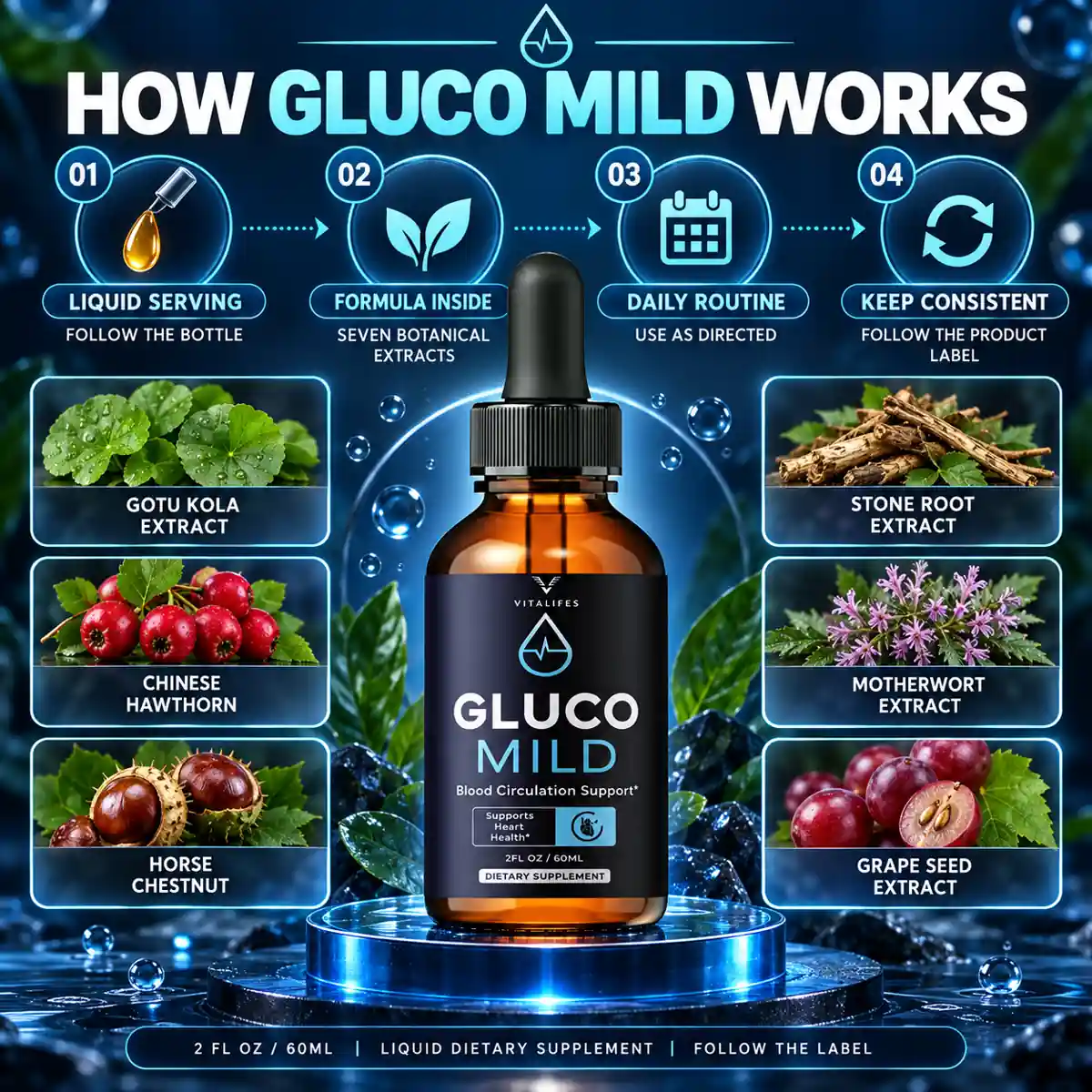
- Two claims are printed: Blood Circulation Support and Supports Heart Health. There is no third.
- The 2020 Cochrane review of phlebotonics names four of the seven botanicals and reports a slight effect on swelling for the class.
- Stone root and motherwort lack any human trial.
- With no amount printed for any ingredient, trial results cannot be carried over to this bottle.
- Nobody has published a before and after measurement for this bottle.
- The label never claims to lower blood sugar, and the product does not. It is not FDA approved.
What does “does Gluco Mild work” really ask?
Searches such as Gluco Mild does it work, does Gluco Mild really work and Gluco Mild results all hide three questions in one. Is there evidence for these plants? Is that evidence about this bottle? And will it do something you can notice? Each has a different answer, so pull them apart.
On the first, some plants have some evidence. On the second, the answer is no, because the bottle prints no amounts and nobody has tested it. The third cannot be known in advance, yet you can find out with a plain record. The seven questions below take these in turn.
Question 1: What does the label say it does?
Just two lines, Blood Circulation Support and Supports Heart Health, and they set the ceiling. They are structure and function statements. Nothing on the label says the product treats, cures or prevents a disease.
Blood sugar, glucose, insulin and A1c are all absent from it. If a blood sugar product is what you hoped for, this is the wrong bottle, and the Gluco in the name is only branding.
Question 2: What have the plants been tested for?
Three of the seven, horse chestnut, butcher's broom and gotu kola, fall into a group called venoactive agents, studied for leg symptoms. The 2020 Cochrane review of that group reports a slight drop in swelling against placebo and little or no change in quality of life.
Hawthorn sits in a heart-failure literature, and its big trial gave a standardised extract, 900 mg daily, for 24 months to people already on prescribed treatment. Grape seed was tested between 200 and 400 mg daily over twelve to sixteen weeks in people with raised blood pressure. Stone root and motherwort have no human trial.
The honest picture is mixed: real studies, mostly small effects, in particular groups of people.
Want to test it rather than argue about it?
One bottle and a simple evening note will tell you more than any page about whether the drops suit you.
See today’s price and guaranteeDisclosure: this website is a retailer and earns money when you buy through its checkout. Not FDA approved, like every supplement. Two drops daily after a meal · 2 fl oz (60 ml) a bottle.
Question 3: Can those trials be matched to this bottle?
No, and that is the central problem. Every trial amount is a weight in milligrams of a standardised extract. This bottle is counted in drops, with no milligram figure and no mention of standardisation. Nothing lines up.
That does not mean the bottle is underdosed, because nobody has published an amount to judge by. It means a trial result cannot be borrowed for this product, whether by you, by this website or by the seller.
A study of horse chestnut seed extract at 50 mg twice daily tells you about that preparation at that amount. It tells you nothing certain about two drops of a seven-plant liquid.
Question 4: What would working look like for you?
Decide before you begin. Most buyers mention heavy legs at day's end. If that is your reason, the measure is easy: a heaviness score out of ten each evening, same hour, same chair, starting the night before the first drop. Add two visible checks, sock-line marks on the ankle and evening shoe tightness.
Without a baseline, week twelve is a guess. With one, it is a comparison. The method is free and closer to what trials measured than a general impression.
Question 5: How long should you give it?
In the trials on these plants, the earliest reading came at four weeks and the commonest at twelve. Buyers in the distributor's summary describe 4-8 weeks. Nothing here was found to resolve in days.
Week one only shows whether a dropper after a meal fits your day. Judging the drops that early is the commonest way to judge them wrongly. Twelve weeks is a fair review point, and you can carry on if your notes say it earned that.
Question 6: What else is changing at the same time?
Many people begin a supplement in the same fortnight as something else. Compression stockings, more walking, less standing, weight change, the weather and salt all move the same symptoms. Vascular-society guidelines rank compression, movement and weight management above any pill or liquid for venous symptoms.
None of these is a reason to skip them. Each is a reason to write its start date beside your notes, so you know in week twelve what deserves the credit. Change one thing at a time if you can.
Question 7: Is it worth it for you?
Answer six plain questions. Do you want circulation and heart support rather than blood sugar support? Has someone who could examine you looked at your symptoms? Are you already moving, standing less and using compression where advised? Can you keep to two drops after one meal for eight weeks? Does a formula without printed amounts feel acceptable? And do any of the medicines in our safety post apply to you?
Five yeses and a no on the last make a reasonable buy. With three yeses or fewer, your money may do more good as compression stockings and a longer walk. The advice is dull, and its evidence is stronger than any bottle's.
What do the claims look like side by side?
| Claim or source | What it says | How far it goes |
|---|---|---|
| Front label | Blood Circulation Support, Supports Heart Health | The ceiling on claims |
| 2020 Cochrane review of phlebotonics | A slight effect on swelling | About a plant class, not this bottle |
| Hawthorn heart-failure trial | 900 mg a day for 24 months, alongside prescribed treatment | A diagnosed group under care |
| Grape seed trials | 200 to 400 mg daily for twelve to sixteen weeks | People with raised blood pressure |
| Stone root and motherwort | No human trial | Tradition only |
| Buyer summary | Most wait 4-8 weeks, main dislike a slow start | The distributor's own figures |
| Before and after | Nobody has published one for this bottle | Nothing to show |
None of these sources describes a measured result for Gluco Mild itself.
What about gluco mild before and after photos and results?
Nobody has published a before and after measurement for this bottle, and none is published here. No buyer in the distributor's summary had an ankle measured. A photo pair on a page cannot show your own legs, and it cannot separate the drops from a summer of walking.
If you want a before and after, make your own with the ten-point note and a photo of the same ankle in the same light every two weeks.
Frequently asked questions
Does Gluco Mild really work?
Nobody can say from the outside. Some of its plants have human trials, mostly showing a slight effect on leg swelling, but the bottle itself has never been trialled and the label prints no amounts. The fair way to find out is a careful record of your own over several weeks.
How does Gluco Mild work?
Three ideas are put forward: tone in the vein wall, the heart literature on hawthorn, and the lining of arteries for grape seed. Two of the seven plants have no human evidence. These are proposals, not proven results for this bottle.
Is Gluco Mild worth it?
That depends on you. It suits adults who want a small daily habit beside movement and compression, accept that amounts are unpublished, and can give it about eight weeks. It is a poor buy for blood sugar goals.
Does Gluco Mild lower blood sugar?
No. Blood sugar, glucose, insulin and A1c are never named on the label, and it does not say the product lowers them.
Is it fair to judge the drops by how my legs look?
Track two visible things: sock-line marks on the ankle and evening shoe tightness. A photo of the same ankle in the same light every two weeks gives a record that does not rely on memory.
Should I stop taking my prescribed medicine for Gluco Mild?
No. Nothing here stands in for a prescribed medicine, and the hawthorn evidence comes from people who carried on taking theirs. Raise any change with your own doctor.
Our view
The fair answer to “does Gluco Mild work” is that it might, a little, for some people, and nobody can tell you in advance. The plants have real research behind them. The bottle gives no amount to link that research to what you pour.
We would not tell anyone it works, and we would not tell anyone it does not. We would say: begin with one bottle, take it as the label says, write one number each evening and decide at twelve weeks.
If one leg swells, heats up, reddens or hurts within hours, call a clinician instead of taking more drops.
Judge it on your own record
The checkout shows the price and the return window, so you can decide how big a test you want.
See today’s price and guaranteeDisclosure: this website is a retailer and earns money when you buy through its checkout. Not FDA approved, like every supplement. Two drops daily after a meal · 2 fl oz (60 ml) a bottle.
Sources named on this site
- The 2020 Cochrane review of phlebotonics for venous insufficiency, by Martinez-Zapata and colleagues. https://pubmed.ncbi.nlm.nih.gov/33141449/
- The SPICE trial of the standardised hawthorn extract. https://pubmed.ncbi.nlm.nih.gov/19019730/
- The 2023 American vascular-society guidelines on varicose veins. https://pubmed.ncbi.nlm.nih.gov/37652254/
- The European Society for Vascular Surgery guidelines on chronic venous disease. https://pubmed.ncbi.nlm.nih.gov/35027279/